
Origin : Poitou, France
Medium : Oolitic limestone with traces of polychromy
Size : H 97cm, W 32cm
Period : Late 12th century, circa 1180 to 1200
Condition : Wear and losses. The left arm is missing. Minor restorations to the face around the right eye, losses to the book.
Price : on demand
REF. 230
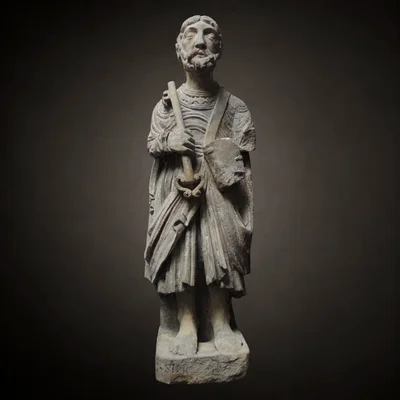
Saint Peter the Apostle, Romanesque Poitou. Late 12th century.
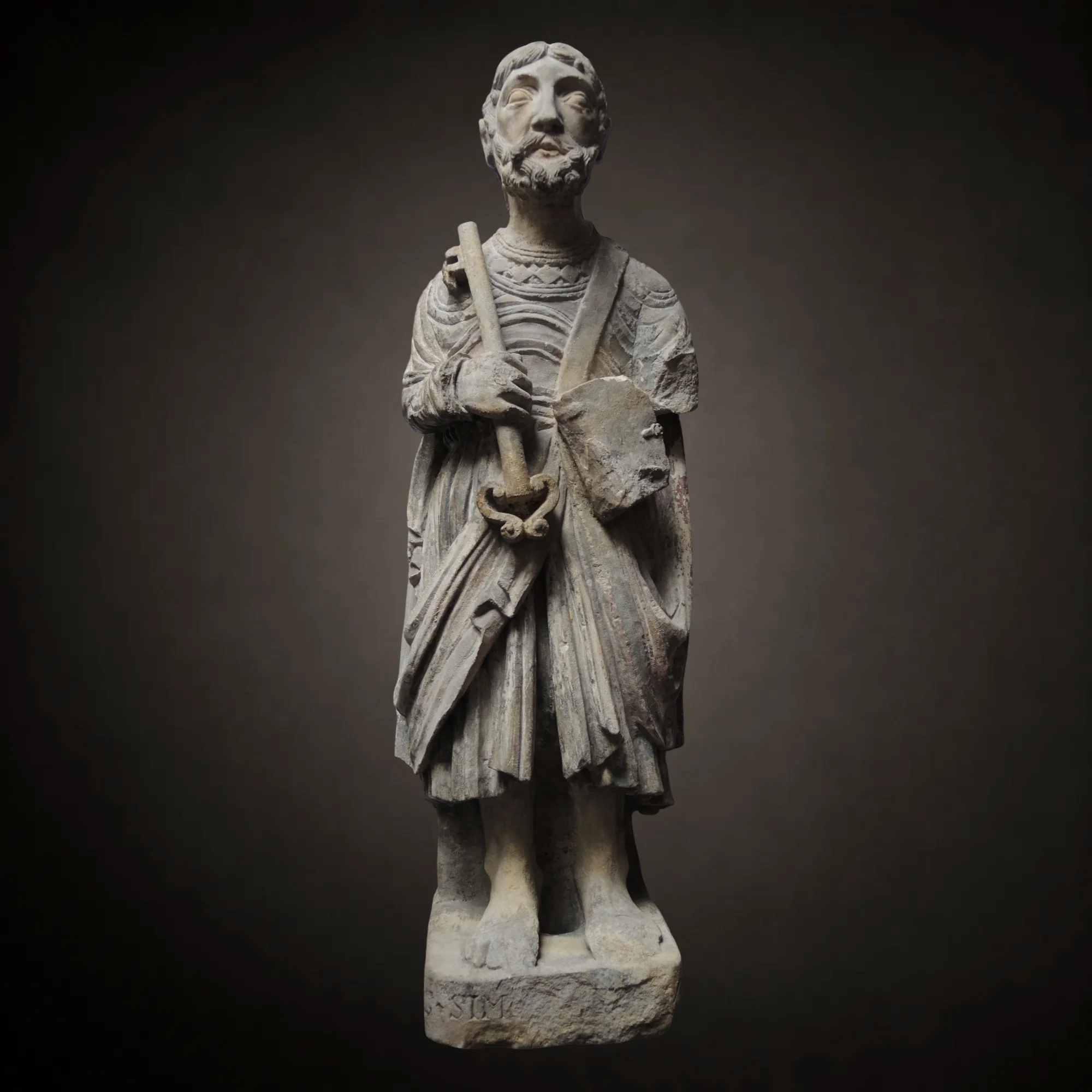
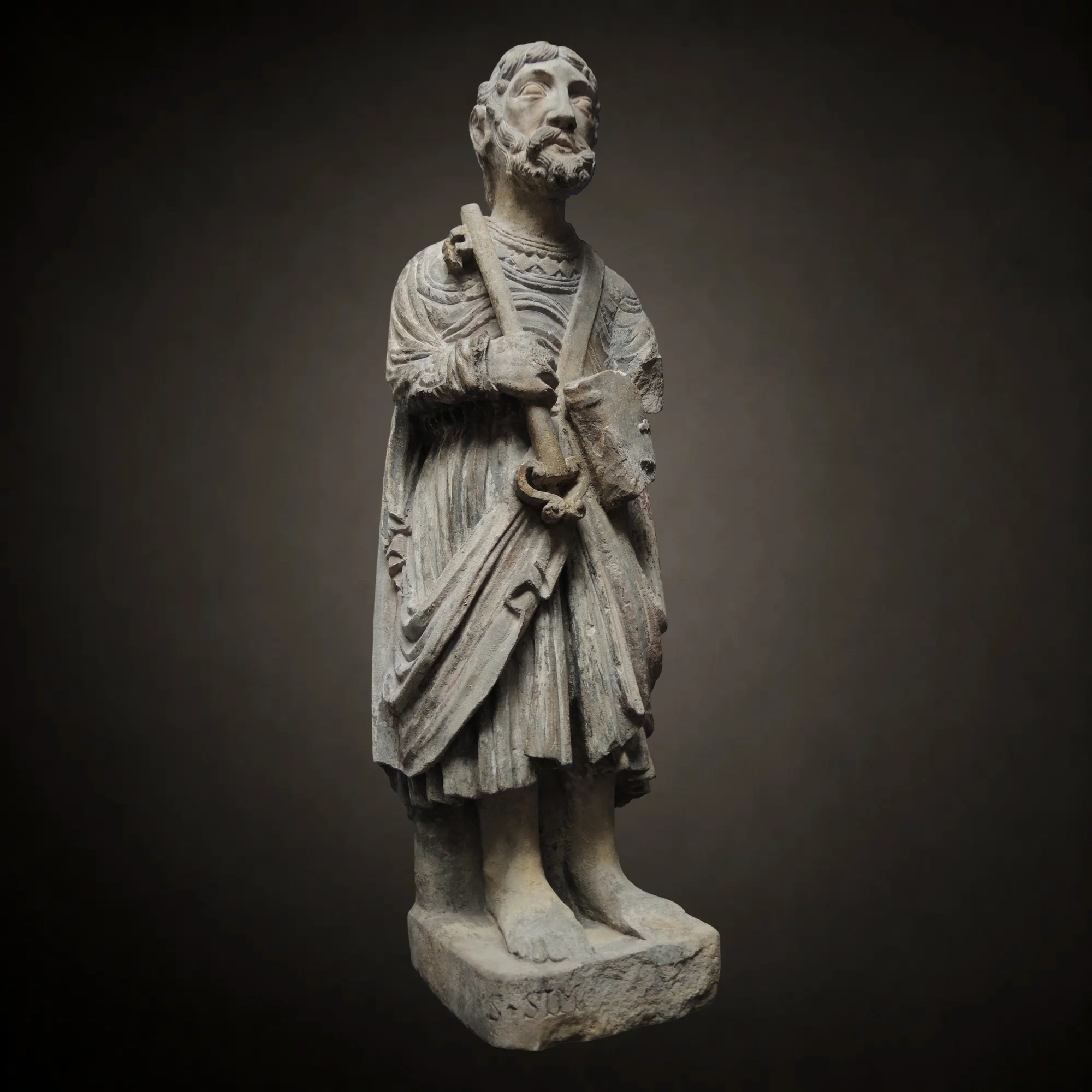
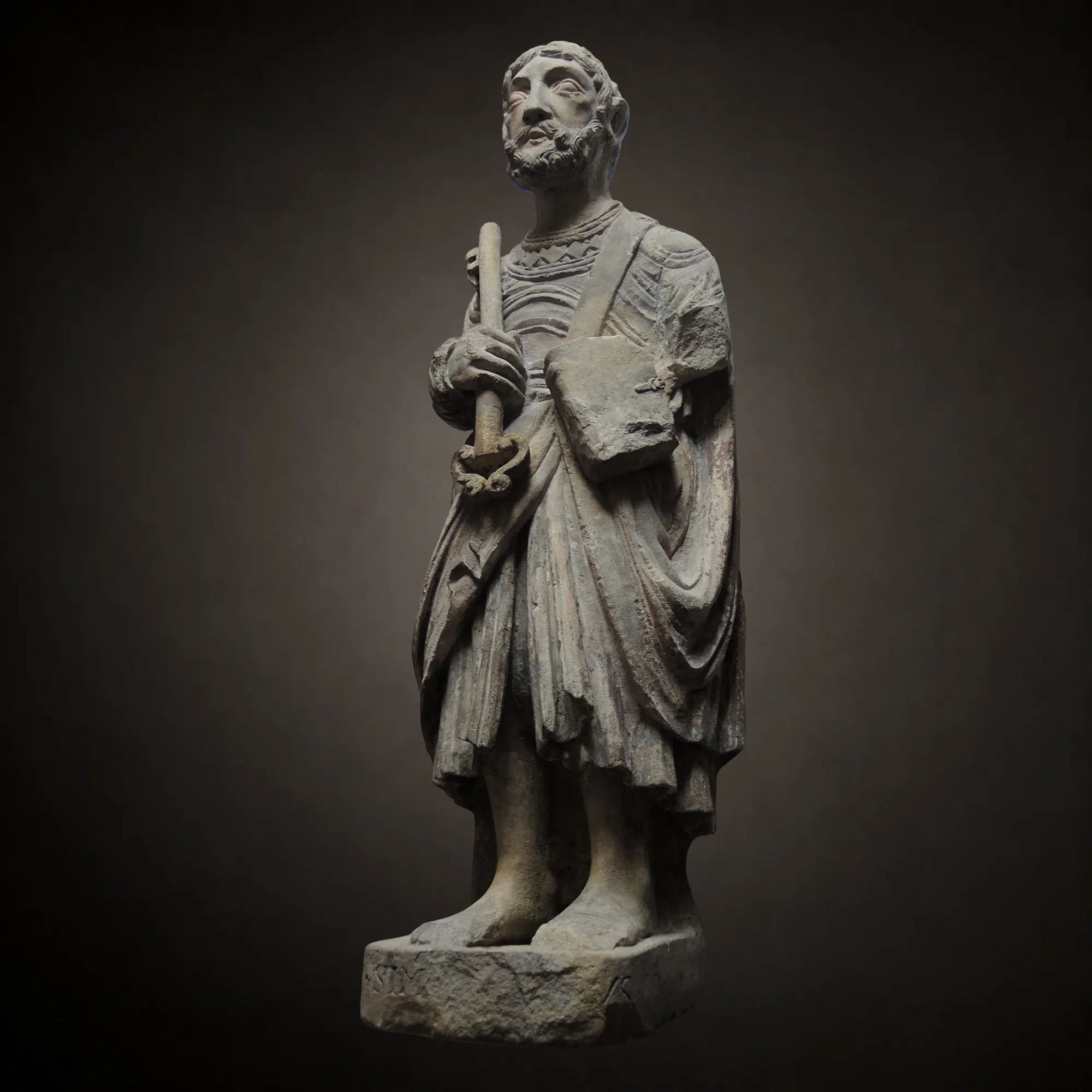
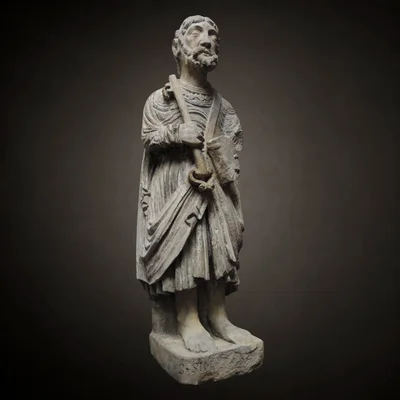
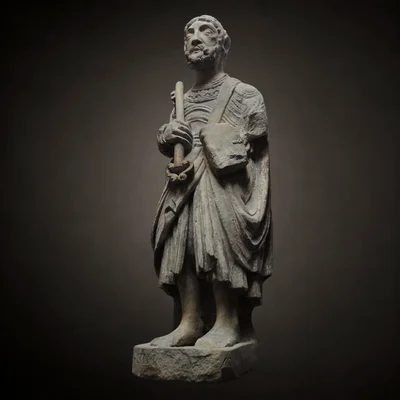
Important monumental figure of Saint Peter the Apostle carved in very high relief from oolitic limestone with traces of polychromy. The work is attributed to Poitou and dated to the late 12th century, circa 1180 to 1200. The apostle stands barefoot on a rectangular base bearing the beginning of an inscription S SIM…, for Sanctus Simon Petrus. The sculpture, conceived almost fully in the round but with a flat back, was intended to be viewed frontally and probably originally stood within an arcade or shallow niche.
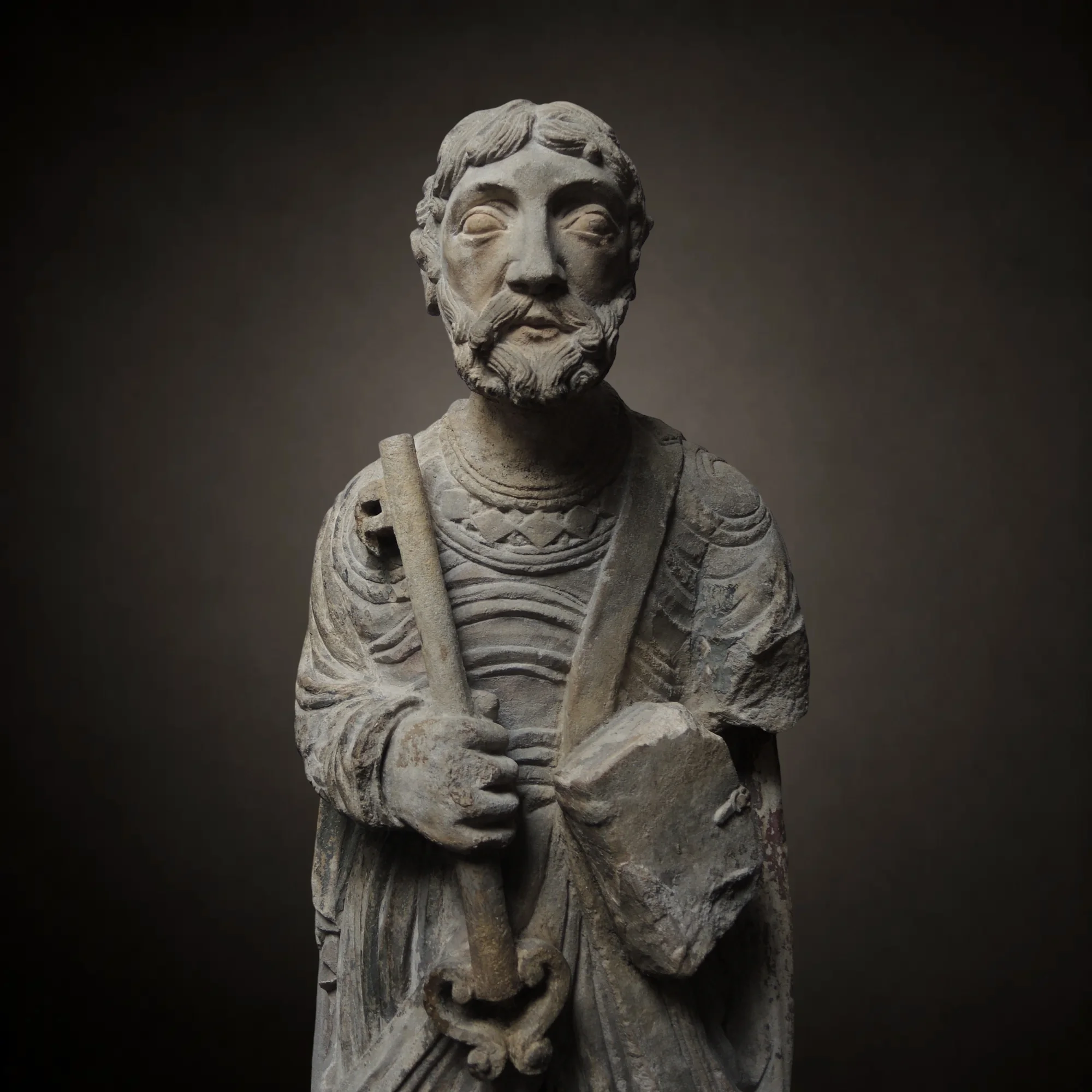
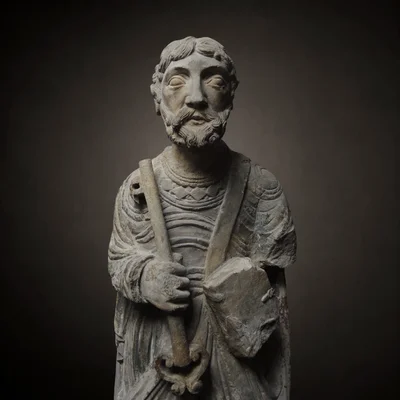
Saint Peter holds in his right hand a key terminating in a remarkable ring decorated with volutes. The left hand, now missing, held the Book, which retains a fine clasp. The frontal and strongly structured face has large prominent almond shaped eyes beneath thick eyelids, a long straight nose and a small half open mouth. The hair and beard are arranged in thick locks marked by fine parallel incisions.
The curving folds of the upper part of the garment are characteristic of 12th century sculpture in Poitou, while the deeper falls of drapery, diagonal sections and increasing independence of the volumes anticipate developments of the end of the century.
Several sculptural ensembles help situate the work within this evolution. The apostles of Notre Dame la Grande in Poitiers provide a typological precedent for frontal apostolic figures integrated within an architectural framework. The façade of Saint Pierre Cathedral in Angoulême offers an important parallel for the breadth and dynamism of the drapery.
Comparison with Sainte Eulalie at Benet is particularly relevant to the modelling of the face. A head of a bearded figure probably originating from Notre Dame de la Couldre in Parthenay, now preserved in the Musée Georges Turpin, Inv. 2005.8.1, also presents significant similarities in the construction of the face.
The apostolic college on the portal of Sainte Marie de Mimizan, dated to the first decades of the 13th century, finally provides an upper chronological limit. Its figures are freer and their draperies more strongly animated by movement. The Saint Peter studied here remains more compact and frontal, while nevertheless showing a clear evolution towards a more volumetric conception. Comparison between these different reference points supports a dating circa 1180 to 1200.
The oolitic nature of the limestone and its consistency with the proposed dating were confirmed by an analysis carried out in 2022 by the Re.S.Artes laboratory.
Complete study available on request.
Bibliography consulted:
Françoise Baron, dir., L’art roman au Louvre, Paris, Fayard et Musée du Louvre, 2005.
Marie Thérèse Camus et Claude Andrault Schmitt, Notre Dame la Grande de Poitiers, l’œuvre romane, Paris et Poitiers, Picard et Centre d’études supérieures de civilisation médiévale, 2002.
Marie Thérèse Camus et Élisabeth Carpentier, Sculpture romane du Poitou, le temps des chefs d’œuvre, Paris, Picard, 2009.
Marie Thérèse Camus, Le regroupement de sculpteurs dans l’aire artistique du Poitou au XIIe siècle, l’exemple de l’atelier de la façade de Benet, dans Architecture, décor, organisation de l’espace, Mélanges offerts à Jean François Reynaud, Lyon, 2013, pages 203 à 214.
Laurence Brugger, De la création d’Ève à la Mandragore décapitée, la façade de l’église Sainte Eulalie de Benet en Vendée, Civilisation médiévale, volume 3, 1996, pages 37 à 53.
Jacques Lacoste, Le portail de Mimizan et ses liens avec la sculpture espagnole du début du XIIIe siècle, Revue de Pau et du Béarn, volume 2, 1974, pages 35 à 69.
In-depth study of the artwork
| Object: | monumental figure of an Apostle, probably originating from an apostolic college |
|---|---|
| Designation: | Saint Peter the Apostle |
| Origin: | Poitou, France |
| Date: | late 12th century, circa 1180 to 1200 |
| Material: | oolitic limestone with traces of polychromy |
| Technique: | sculpture in very high relief |
| Dimensions: | height 97 cm; width 32 cm |
| Condition: | wear and damage. The left arm is missing. Minor restorations to the face, around the right eye, and losses to the book. |
| Scientific analysis: | the oolitic nature of the limestone and its consistency with the proposed dating were confirmed by an analysis carried out in 2022 by the Re.S.Artes laboratory. The sculpture was examined by Elodie Jeannest de Gyvès, medieval art expert at Sculptures & Collections. |
| Provenance: | private collection, France; public sale, France |
| Reference: | 230 |
Description
The Apostle stands barefoot on a rectangular base bearing an inscription. The figure is conceived along a strictly vertical axis. The head, torso and legs are aligned within the same frontal plane.
The face is broad in its upper part and narrows toward the chin. The long, straight nose forms the principal axis of the composition. The large, projecting almond shaped eyes are set beneath thick and clearly defined eyelids. The brow ridges continue toward the temples without any marked break. The small, slightly open mouth is framed by a moustache arranged in two symmetrical masses.
The hair is divided by a central parting. Broad, curved locks follow one another across the forehead, each marked by fine parallel incisions. At the sides, the hair ends in shorter curls that leave the ears exposed. The beard is constructed according to the same principle. Two hook shaped locks emphasize the cheeks, while the masses below the mouth and around the chin divide into curved points. The face does not yet display the naturalistic character of Gothic sculpture.
The costume combines a tunic with a richly decorated neckline and a mantle. Beneath the double line of the collar is a braid decorated with lozenges. The upper torso is covered by curved folds arranged in successive arcs. The same vocabulary continues across the shoulders and along the right sleeve, where the folds tighten into parallel ribs.
In the lower part, the treatment changes noticeably. The folds become longer, deeper and predominantly vertical. At the side, the mantle forms a succession of nested curves before turning into oblique panels ending in sharply marked angles. This combination of concentric curves, vertical falls and oblique breaks is one of the sculpture's most significant characteristics.
The right hand holds the key, which ends in a remarkable ring with scrolls, while the now missing left hand held the Book fitted with a fine clasp.
The base preserves the beginning of the titulus “S SIM…”, for Sanctus Simon Petrus.
Material and technical study
The work is carved from oolitic limestone, a material identification confirmed by analysis carried out by the Re.S.Artes laboratory. Its regular grain is well suited both to the carving of continuous volumes and to the fine incisions of the hair, beard and garment borders.
The sculpture is almost fully in the round, but the back is flat, indicating that the work was intended to be viewed frontally. The Apostle must have been incorporated into an architectural setting, probably within an arcade or a shallow niche.
Faint traces of polychromy survive on parts of the garment. Red tones are visible in particular on the left side, while a few grey blue and greenish areas remain in the recesses.
Geographical and stylistic context
The attribution to Poitou cannot rest solely on the identification of oolitic limestone, which occurs in several regions of western and northern France. It results from the convergence of the material, the architectural conception of the relief and a group of formal characteristics observed in Poitevin sculpture.
During the 12th century, the great sculptural programmes of Poitou gave increasing prominence to the human figure. Figures developed across facades, portals and registers of arcades, where prophets and Apostles formed part of compositions governed by architecture. The frontality of the figures, the clarity of the silhouettes and the repetition of clothing schemes ensured the unity of these ensembles.
The screen facade is one of the most characteristic expressions of this monumental culture. It provided sculpture with a broad surface on which figures could be distributed in registers, arcades or the archivolts of portals. The figures were not always subordinated to the logic of a narrative scene.
The difference between the upper and lower parts of the garment is significant both chronologically and geographically. The curving folds across the torso are typical of Poitevin sculpture of the mid 12th century, while the depth of the falling folds and the increasing autonomy of the panels anticipate developments at the dawn of the 13th century.
The face follows the same logic. Its frontality and symmetry remain strongly Romanesque, as do the anatomical details, the eyes, hair and beard, which correspond fully to the canon of Poitevin Romanesque art. The hair and beard do not yet seek the continuous suppleness of early 13th century sculpture. Their arrangement into distinct and deeply incised locks remains ornamental.
These characteristics connect the work with Poitevin sculpture of the final decades of the 12th century. They do not make it possible to identify a specific workshop.
Comparative corpus and dating
Notre Dame la Grande, Poitiers
The facade of Notre Dame la Grande in Poitiers provides the first landmark for understanding the development of apostolic colleges in monumental Poitevin sculpture. It presents the Apostles beneath arcades. The repetition of the figures establishes a regular sequence in which each figure is individualized. Saint Peter is identified by his keys.
Some faces also display large almond shaped eyes, continuous brow ridges and facial hair organized into symmetrical locks. The present sculpture is nevertheless distinguished by greater depth, a head more fully detached from the background and a more complex animation of the mantle. It therefore belongs to a noticeably later phase of Poitevin sculpture.
Executed during the first half of the 12th century, these figures predate the present work. Their importance is primarily typological. They establish, within the Poitevin context, the use of frontal apostolic figures placed within an architectural framework and individualized by their attributes.
Cathedral of Saint Peter, Angoulême
The facade of the Cathedral of Saint Peter in Angoulême provides an essential parallel for the superimposition of draperies. On several Apostles in the blind arcades, dated to the first half of the 12th century, the garments expand into broad triangular panels. Vertical folds are interrupted by oblique turnbacks, while the borders rise around the legs and feet. This organization creates a breadth and mobility that reappears in the lower part of the present Saint Peter. The tunic and mantle do not form a uniform screen. They cross, overlap and build up a succession of projecting and recessed planes.
Angoulême is a major regional precedent for a dynamic and ample conception of drapery. The comparison shows that the present Saint Peter extends, in a more volumetric and probably later formulation, a monumental tradition already established in Angoumois during the first half of the 12th century.
Saint Peter at Aulnay
The sculpture of the southern portal at Aulnay, generally dated to around the middle of the 12th century, provides another landmark for the study of Poitevin formal vocabulary. The figures arranged in the archivolts wear garments articulated by parallel lines, nested curves and tubular folds.
At Aulnay, the comparison concerns the syntax of the folds, especially the succession of regular curves across Saint Peter's torso. In the present sculpture, however, the greater depth of the recesses and the detachment of the panels indicate a more advanced stage.
Saint Nicolas, Civray
The screen facade of Saint Nicolas at Civray, typical of Poitevin Romanesque churches, is organized into large arcades on two levels. The upper right arcade has preserved its monumental figures in two registers. In the upper register, four figures hold books or phylacteries. They may represent prophets, Apostles or Evangelists.
During the 19th century restoration of the facade, whose intervention on the sculptures of the upper right arcade consisted of aggressive cleaning, traces of red and blue polychromy were observed on the sculptures. The figures wear garments typical of Poitevin and Saintongeais art, with almost concentric folds and no break in line between the upper and lower parts of the costume.
Civray is an interesting marker for the present study, but it is also earlier, belonging to the second half of the 12th century at the height of Poitevin Romanesque art.
Sainte Eulalie, Benet
The facade of Sainte Eulalie at Benet provides an interesting comparison for the artistic milieu of the second half of the 12th century. The comparison is especially relevant to the treatment of faces and garments on the figures set within the archivolts of the portal or on the engaged capitals. As in the present sculpture, the eyes are full and projecting, while the garments become less densely concentrated in circular folds. The eyes are widely open beneath continuous brow ridges. The hair and beard are divided by parallel grooves. The garments alternate curved folds, vertical bands and angular ends. The surface remains highly graphic, but the volumes gain in depth and autonomy.
The present figure appears to belong to this moment of renewal. It retains the stability and abstract organization of Romanesque works from the middle of the century while developing greater freedom in the falling sections of the mantle. With regard to the mixing of styles, Marie Thérèse Camus's study of the sculptors of the Benet facade demonstrates precisely the value of reasoning in terms of groupings and the circulation of practitioners rather than completely isolated workshops.
With a completion range for the facade extending to around 1150 to 1160, Sainte Eulalie provides a closer chronological marker, though it remains earlier than the Saint Peter studied here.
Notre Dame de la Couldre, Parthenay
The head of a bearded figure preserved at the Musée Georges Turpin in Parthenay, inventory 2005.8.1, is traditionally attributed to Notre Dame de la Couldre and dated to the second half of the 12th century. Measuring 22 cm in height, it belonged to a figure whose body has disappeared.
The comparison with Saint Peter primarily concerns the construction of the face. In both works, strongly projecting eyeballs are set in hollowed sockets beneath lightly emphasized brow ridges that continue toward a straight nose. The moustache is clearly separated from the beard, while the hair and facial hair are divided into thick locks marked by parallel incisions.
The Parthenay head nevertheless has a narrower face and longer side locks that descend and merge with the beard. On Saint Peter, the facial hair is distributed more symmetrically around the cheeks and chin, in shorter and more strongly individualized hook shaped locks.
This comparison provides an important argument in favour of a Poitevin origin. It shows that the treatment of Saint Peter's eyes, nose and facial hair belongs to developments attested at Parthenay during the second half of the 12th century. It therefore supports a dating to the final decades of the century without allowing the sculpture to be assigned to the workshop of Notre Dame de la Couldre.
Sainte Marie, Mimizan
The portal of Sainte Marie at Mimizan provides the most significant functional comparison. The Apostles are shown standing in high relief around Christ. They are individualized by their attitudes and by inscriptions. The ensemble follows the logic of a monumental apostolic college in which each figure retains its autonomy while forming part of a series.
Mimizan is, however, later. Marcel Durliat dates the portal to the first decades of the 13th century and recalls its connections with northern Spanish sculpture studied by Jacques Lacoste.
The Apostles at Mimizan display freer bodies, more varied poses and draperies more fully governed by movement. The folds wrap around the volumes rather than being superimposed mainly on the surface. The present figure remains more compact. Its axis is more rigid and the curves across the torso retain their abstract value.
Mimizan therefore provides an upper chronological limit. The similarity in function and format brings the two ensembles together, while differences in modelling suggest placing the present sculpture before the full development represented by the Mimizan portal.
Proposed dating
Comparison of the corpus makes it possible to distinguish four levels. Notre Dame la Grande and Aulnay provide the regional precedents for the apostolic programme and linear drapery. Angoulême, although farther south, demonstrates the presence of dynamic draperies as early as the first half of the 12th century. Benet and Civray illuminate the apogee of Poitevin Romanesque art during the second half of the 12th century. Mimizan reveals the freer and more volumetric culmination of these developments at the beginning of the 13th century.
The figure of Saint Peter falls between the last two phases. It retains the frontality, symmetry and conventional folds inherited from the middle of the century, but deepens the relief and individualizes the volumes. A date around 1180 to 1200 therefore appears coherent.
The attribution to Poitou is based on this position within a regional development, on the architectural conception of the figure, and on the combined treatment of the face, hair and garments. In the absence of a surviving ensemble showing sufficiently close correspondences, no more precise workshop attribution should be proposed.
Selected bibliography
- Baron, Françoise, ed., L'art roman au Louvre, Paris, Fayard and Musée du Louvre, 2005.
- Camus, Marie Thérèse, and Andrault Schmitt, Claude, Notre Dame la Grande de Poitiers, l'œuvre romane, Paris and Poitiers, Picard and Centre d'études supérieures de civilisation médiévale, 2002.
- Camus, Marie Thérèse, and Carpentier, Élisabeth, Sculpture romane du Poitou, le temps des chefs d'œuvre, Paris, Picard, 2009.
- Camus, Marie Thérèse, “Le regroupement de sculpteurs dans l'aire artistique du Poitou au XIIe siècle, l'exemple de l'atelier de la façade de Benet”, in Architecture, décor, organisation de l'espace, Mélanges offerts à Jean François Reynaud, Lyon, 2013, pp. 203 to 214.
- Brugger, Laurence, “De la création d'Ève à la Mandragore décapitée, la façade de l'église Sainte Eulalie de Benet en Vendée”, Civilisation médiévale, vol. 3, 1996, pp. 37 to 53.
- Lacoste, Jacques, “Le portail de Mimizan et ses liens avec la sculpture espagnole du début du XIIIe siècle”, Revue de Pau et du Béarn, vol. 2, 1974, pp. 35 to 69.
- Durliat, Marcel, “La place du portail de Mimizan”, Bulletin monumental, vol. 133, 1975, pp. 261 and 262.